The short answer
If you are asking where to go, the honest answer is a grocery store — or nowhere at all. Miami has no meaningful crypto storefront market. What it has is kiosks in convenience stores, flat-fee counters inside supermarkets, and an institutional cluster in Brickell for large trades. For cash, use the supermarkets. For anything else, an online exchange beats every address in the city on price.
~229
crypto ATMs listed across Miami before the 2026 shutdown
300+
bitcoin-enabled Coinstar kiosks launched across Florida grocery stores
~25
separate kiosk operators have served the Miami market
1
neighbourhood where six-figure trades actually happen: Brickell
The five venue types you will encounter
Before the geography, the taxonomy — because “where to buy crypto in Miami” means five quite different things, and mixing them up is how people end up paying a fifth of their money for the privilege of standing somewhere.
Convenience-store kiosks are the most visible option and the most expensive. A third-party operator rents floor space in a bodega, gas station, smoke shop or phone-repair store. The shop is a landlord and its staff cannot help you with fees, limits or a failed transaction. All-in costs commonly run 10% to 25% once the exchange-rate spread is counted.
Supermarket flat-fee services are the same idea done properly. Coinme operates retail counters where you hand cash to a cashier, plus bitcoin-enabled Coinstar machines, inside chains including Winn-Dixie, Fresco y Más, Harveys and Walmart. Florida got more than 300 of these Coinstar kiosks. The service fee is flat — roughly $2.75 to $5.75 depending on venue — rather than a percentage, which changes the arithmetic completely.
Remittance windows are the third cash route. Coinme's partnership with MoneyGram covers around 11,500 US locations, and in a city with Miami's remittance volume these are often closer than a supermarket.
Institutional offices exist, but not for you unless you are trading at scale. Brickell hosts OTC desks, funds, family-office advisers, and crypto-native legal and accounting practices. These are appointment-only relationships, generally sized for trades above roughly $50,000. See OTC desks in Miami.
Online platforms are the fifth and, on cost, the only sensible default. No venue, no travel, no spread beyond a small commission. Everything physical in Miami is charging you for immediacy.
Area by area
Density figures below are relative rather than absolute, and reflect the market before and after the May 2026 shutdown of the largest national operator.
Brickell
Institutional coreMiami’s financial district and the centre of gravity for everything serious. OTC desks, digital-asset funds, family-office advisory, crypto tax and legal practices. Almost no street-level kiosks — the population here transacts by wire, not with notes. If your order has five or six figures in it, this is where the conversation happens.
Cash kiosk density
Downtown & Flagler Street
Densest retail clusterHeavy foot traffic, transit interchanges and a long tail of small independent retail. Historically the thickest concentration of kiosks in the city — and consequently the area with the most dead terminals since May 2026. Also where you will find the widest spread between two machines a block apart, which makes comparison genuinely worthwhile.
Cash kiosk density
Little Havana
Cash & remittance overlapAlong SW 8th Street the cash-to-crypto market sits directly on top of the remittance market. Bodegas, money-transfer windows, small supermarkets and smoke shops host terminals. This is also where the flat-fee alternatives are most valuable, because grocery options and Fresco y Más locations are close by and cost a fraction of the kiosk next door.
Cash kiosk density
Wynwood & Edgewater
Crypto-nativeWhere the industry socialises and, increasingly, works — Blockchain.com moved its US headquarters here into a 22,000 sq ft space at Cube Wynwd. Merchant acceptance is unusually good for a US neighbourhood, so this is a better place to spend crypto than to buy it. Kiosks are scattered through smoke shops and corner stores rather than clustered.
Cash kiosk density
Miami Beach & South Beach
Tourist pricingWell covered and consistently the worst value in Miami-Dade. Machines are placed where visitors will find them and priced for people who will not compare. Convenience is excellent, cost is not. Full detail, including the mainland alternatives worth the drive, in our Miami Beach guide.
Cash kiosk density
Hialeah & north-west corridor
Growing cash marketA large cash economy with strong remittance flows, served by both kiosks and grocery-based options. Coinme locations in Walmart Supercenters around Miami Gardens and the north-west of the county make this one of the better-served areas for flat-fee cash conversion.
Cash kiosk density
Coral Gables & Coconut Grove
Underserved by designHigh income, low kiosk density. Residents here overwhelmingly use exchanges, cards and advisers rather than machines, and the market has responded accordingly. If you need physical cash conversion, your nearest realistic option is usually a supermarket rather than a standalone terminal.
Cash kiosk density
Kendall, Pinecrest & South Dade
The real market gapThe thinnest coverage in the county relative to population and income. Long distances between machines, and several residential pockets with nothing within a reasonable drive. Grocery-based Coinstar kiosks are the practical answer here, and an online exchange is the sensible one.
Cash kiosk density
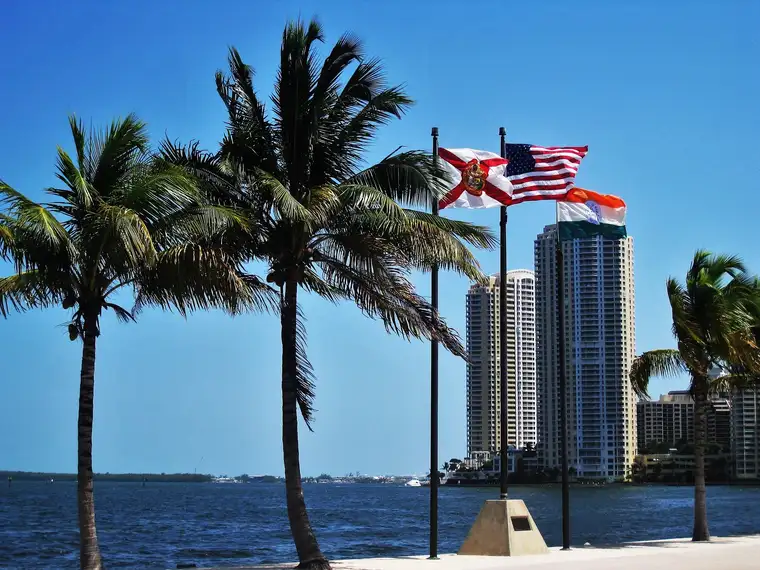
The airport, and other captive locations
Miami International Airport has hosted a bitcoin ATM, installed by Bitstop — which is itself a Miami company, founded here in 2013. It is a neat detail about this city's place in the industry: Bitstop's founders went on to acquire Genesis Coin, the software platform behind roughly a third of the world's bitcoin ATMs, and moved that company's headquarters from Puerto Rico to Miami. In a real sense the technical centre of the American kiosk industry is here, whatever the operator league table says.
As a place to buy, though, treat the airport the way you treat airport currency exchange. Captive demand produces captive pricing. The same logic applies to machines inside hotels, cruise terminals, nightlife venues and any location where the alternative is a long walk. If you are standing somewhere you cannot easily leave, you are the wrong side of the negotiation.
Where the gaps are, and what to do about them
Kiosk placement follows cash-handling businesses, not people. That produces a counter-intuitive map in Miami-Dade: some of the wealthiest parts of the county are the worst served, because their residents do not use cash for anything. Coral Gables, Pinecrest, Palmetto Bay and much of Kendall have very thin coverage. Meanwhile Downtown, Little Havana and the north-west corridor have machines within a few blocks of each other.
If you live in the gap, the practical hierarchy is straightforward. Use an online exchange if you have a bank account. If you are holding cash, find the nearest Winn-Dixie, Fresco y Más or Walmart Supercenter with a Coinme or Coinstar service — the grocery footprint in South Dade is far better than the kiosk footprint, and the pricing is not close. Only consider a standalone terminal if neither is reachable.
By area What we would actually use, depending on where you are
| If you are in… | Best physical option | Why |
|---|---|---|
| Brickell / DowntownFinancial core | Online exchange; OTC above $50k | Dense kiosks but uniformly poor value. Everyone here with size uses a desk instead. |
| Little HavanaSW 8th Street | Grocery Coinme / Coinstar | Flat fee instead of a percentage, and the supermarket options are genuinely close by. |
| Wynwood / EdgewaterDesign District | Online exchange; spend locally | Better neighbourhood for spending crypto than buying it. Merchant acceptance is unusually high. |
| Miami BeachSouth, Mid, North | Cross to the mainland, or go online | Barrier-island pricing is the worst in the county. Convenience is real; so is the premium. |
| Hialeah / Miami GardensNorth-west | Walmart Coinme counter | Some of the best flat-fee cash coverage in Miami-Dade, with a cashier and a receipt. |
| Kendall / South DadeSuburban south | Online exchange, or grocery kiosk | Kiosk coverage is the thinnest in the county. Do not drive across town to overpay. |
We have deliberately not published individual street addresses. Kiosk hosts change monthly and stale addresses waste your time — the operator locators are the only reliable source.
Choosing a venue on price, in two minutes
Whatever the address, the test is the same. Get to the confirmation screen, look at the quantity of crypto you are being offered, and compare it against the market price on your phone. Everything else — the branding, the neighbourhood, the promise of no fees — is noise.
Our threshold: if the implied cost is above about 8%, leave. In Miami there is almost always another option within a mile, and there is certainly a cheaper one on your phone. The only situation where we would accept a double-digit spread is a genuine emergency involving physical cash and a hard deadline, and even then we would try a supermarket first.
One more thing worth saying plainly, because it comes up in reader email more than any other topic: never arrange to meet a stranger in person to swap cash for crypto. Not in a car park, not in a coffee shop, not with an escrow promise. The trade cannot be reversed and you have no recourse. Florida ranked second in the country for crypto kiosk fraud in 2025 with roughly $32.7 million lost across 1,213 complaints, and in-person cash meets are worse than kiosks, not better. Read the Miami scam playbooks before you agree to anything.
The bottom line
The best place to buy crypto in Miami is not a placeMiami is one of the most crypto-saturated cities in America and it still has no good physical retail option, because the economics do not support one. What it has is a supermarket network that does the cash job for a flat few dollars, a convenience-store network that does the same job for ten to twenty-five percent, and a Brickell institutional layer for people moving real size.
Match the venue to the job. Cash and impatient: grocery store. Cash and patient: bank branch, then online. Card or bank account: online, on the advanced interface. Above $50,000: a desk in Brickell. There is no sixth answer worth driving for.